

WE ARE NOT STARTING
FROM THE SCRATCH
Already in the early modern period, intellectual circles in the Kingdom of Hungary developed an interest in testimonies of the country’s written cultural heritage, primarily in the form of research into literary history. The language of the studied monuments became a more significant criterion for research only at the turn of the eighteenth and nineteenth centuries, when Slovak scholars—initially again through literary-historical inquiry and later through interest in folk literature—began to focus on written testimonies of the Slovak language from earlier periods. In this context one may mention figures such as Bohuslav Tablic, Ján Kollár, Pavol Jozef Šafárik, and Jozef Miloslav Hurban.
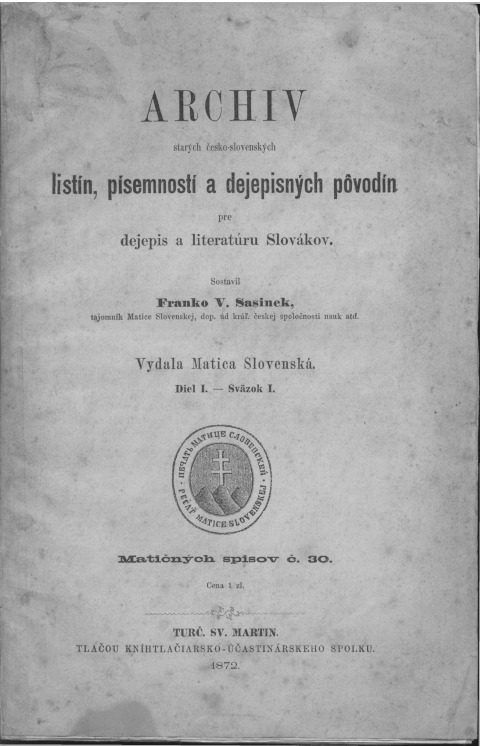
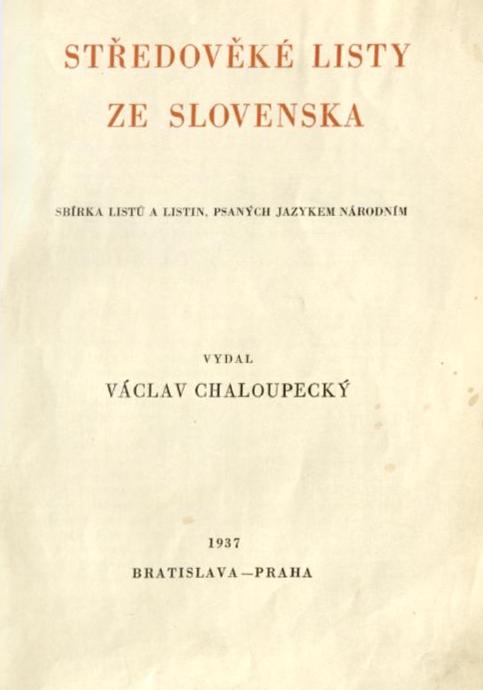
Václav Chaloupecký published two key editions already in the interwar period:
* Václav Chaloupecký (ed.): Kniha Žilinská. Bratislava: Učená společnost Šafaříkova, 1934, 239 pp.
*Václav Chaloupecký (ed.): Středověké listy ze Slovenska: Sbírka listů a listin, psaných jazykem národním. Bratislava: Učená společnost Šafaříkova, 1937, 266 pp.
Both editions resulted from a systematic interest in Slovak texts from the pre-standardization period, albeit with several limitations. One of them is the chronological restriction to the fifteenth century.
A more serious limitation, however, is the phonetic transcription, which obscures the linguistic diversity of the texts and the influences that shaped them.
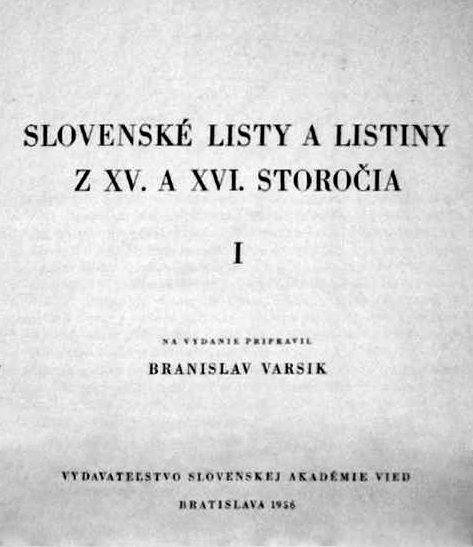
The work was continued by the Slovak historian Branislav Varsik—Chaloupecký’s student and critic—who in the first volume of a planned edition (ultimately never completed) focused on what is now western Slovakia:
*Branislav Varsik (ed.). Slovenské listy a listiny z XV. a XVI. storočia, vol. 1. Bratislava: Vydavateľstvo Slovenskej akadémie vied, 1956, 437 pp.
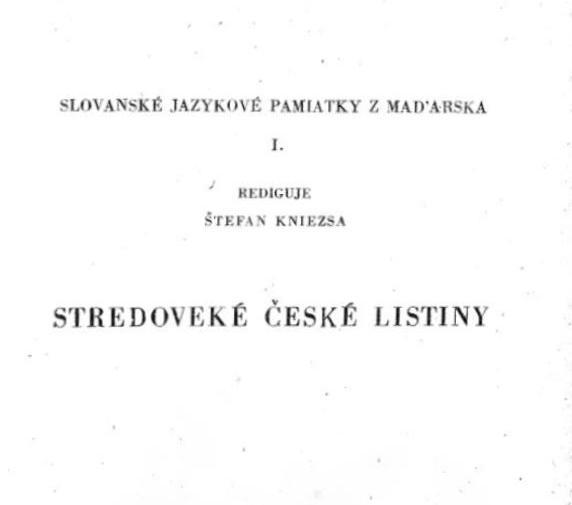
Interest in the use of Slovak within the Hungarian context was not confined to (Czecho-)Slovak historiography, as evidenced by the example of the Hungarian Slavist István Kniezsa, who in the first volume of his edition published medieval Slovak texts from the collections of the Hungarian National Archives in Budapest:
*István Kniezsa (ed.). Stredoveké české listiny. Budapest: Akadémiai Kiadó, 1952, 206 pp.
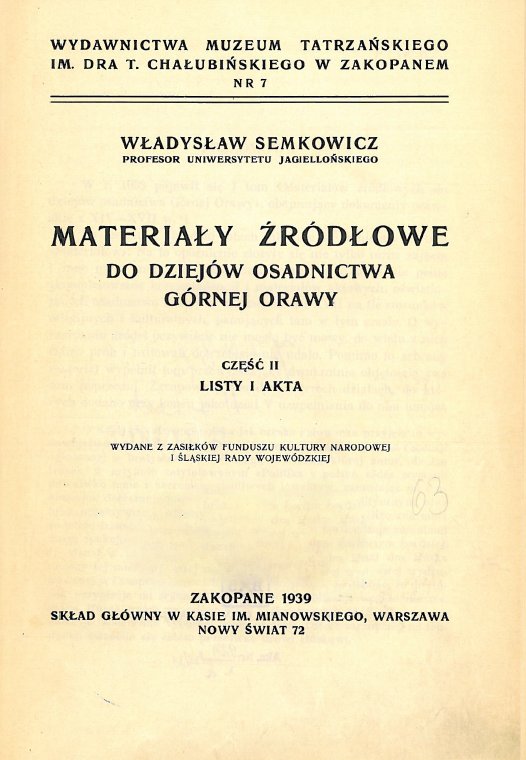
The topic also attracted the interest of Polish historians, as demonstrated by the work of Władysław Semkowicz, who focused on the situation in Orava:
*Władysław Semkowicz (ed.). Materiały do dziejów osadnictwa Górnej Orawy, vol. 1: Dokumenty. Zakopane: Nakładem Muzeum Tatrzańskiego, 1932, 199 pp.
*Władysław Semkowicz (ed.). Materiały do dziejów osadnictwa Górnej Orawy, vol. 2: Listy i akta. Zakopane: Muzeum Tatrzańskie, 1939, 480 pp. + 3 maps.
After these projects, research was conducted mostly through the initiatives of individual scholars, both historians and linguists. Among the latter it is necessary to mention Ján Stanislav (the five-volume History of the Slovak Language), Jozef Orlovský (together with the archivist and historian Darina Lehotská, The Oldest Municipal Book of Jelšava, 1560–1710), as well as the team of linguists responsible for the Historical Dictionary of the Slovak Language, published in 1991–2008, and for the selection of texts in the three-volume Sources for the History of Slovak. Further contributors include Eugen Paulíny, Rudolf Krajčovič, Šimon Ondrušovič, Ján Doruľa, Matej Považaj, Milan Majtán, Pavol Žigo, Rudolf Kuchár, Jana Skladaná, and Gabriela Múcsková; among historians, Peter Ratkoš and Pavol Horváth.
